Development summary
A clear description of the proposed development and the works relevant to existing trees.
Our Services
Areas We Service
Tree requirements, AQF Level 5 Arborist Reports, AIA, TPZ, SRZ and construction compliance
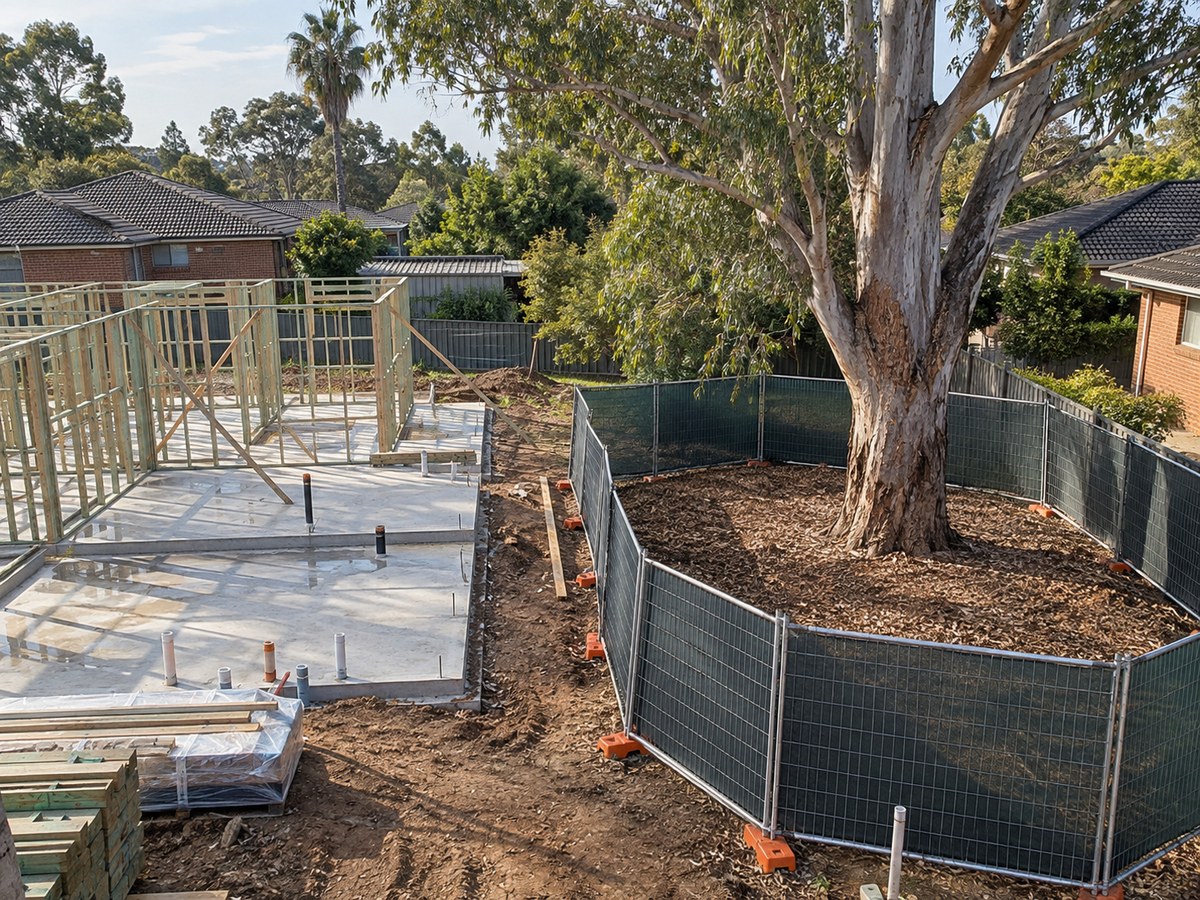
Trees can influence building footprints, excavation, driveways, services and construction methodology before a Development Application is determined. Identifying those constraints early gives the project team an opportunity to respond before the design is finalised.
Liverpool Tree Permit Services prepares Development Arborist Reports, DA Arborist Reports, DA Tree Reports and Arboricultural Impact Assessments (AIAs), assesses Tree Protection Zones (TPZs) and Structural Root Zones (SRZs), investigates tree roots where required and provides Project Arborist support through construction.
An Arborist Report for a Development Application may be required where:
Trees do not necessarily have to be located within the development property to be relevant. Adjoining trees and Council-managed trees may also need to be considered where their Tree Protection Zones or root systems extend into the development site.
If you are removing or pruning a tree as a standalone matter unrelated to a Development Application, see the Liverpool Tree Removal & Pruning Guidelines instead.
Liverpool City Council's Tree Management Technical Guidelines set out requirements for arboricultural reports associated with tree management and development. Where a Tree Report is required for a development matter, the applicable Liverpool requirements should be checked to establish the required arboricultural information, assessment methodology and consulting-arborist qualification.
For Development Applications involving trees, this may include assessment of:
Development arboricultural assessment should be prepared with reference to Liverpool City Council's applicable requirements and the applicable edition of AS 4970, Protection of Trees on Development Sites.
An Arboricultural Impact Assessment evaluates how proposed development may affect existing trees and identifies appropriate measures for tree retention, protection and management.
A clear description of the proposed development and the works relevant to existing trees.
Assessment of relevant trees, their retention value and their Tree Protection Zones and Structural Root Zones. The supplied Liverpool Technical Guidelines material also identifies assessment of trees within 5 metres of property boundaries and adjoining-tree TPZs extending into the development site.
Trees proposed for retention and removal, TPZ and SRZ interaction with proposed works, the extent of development encroachment, whether encroachment is classified as minor or major, and where appropriate, mitigation measures or alternative tree-sensitive design options.
Where development requires pruning, the assessment may need to document the proposed pruning, relevant branch sizes and locations, photographs and the estimated proportion of the crown affected.
Scaled plans can identify trees proposed for removal and retention together with relevant tree-protection areas and their relationship with the proposed development.
Preparing arboricultural information against the applicable Liverpool requirements from the outset can reduce the risk of Council requesting additional arboricultural information during assessment.
Start with the situation you are in. If you are not sure, send us your plans, Council correspondence or a description of the proposed work and we can identify the appropriate service before you proceed.
| Your situation | Arborist service |
|---|---|
| Lodging a Development Application involving trees | Development Arborist Report, DA Arborist Report or AIA |
| Removing a protected tree unrelated to a DA | Tree Removal Report |
| Significant tree pruning unrelated to a DA | Tree Pruning Report |
| Retaining trees during construction | Tree Protection Plan |
| Development Consent requires arborist supervision | Project Arborist Services |
| Excavation, driveway or footings near a retained tree | Tree Root Investigation & Mapping |
| Retained tree showing decline or damage during works | Health & Safety Tree Assessment |
Tree Protection Zones and Structural Root Zones are important considerations when development is proposed close to retained trees. The Tree Protection Zone defines an area associated with protecting a tree's health and long-term viability during development. The Structural Root Zone relates particularly to the tree's structural stability and the root system close to the trunk.
An Arboricultural Impact Assessment can consider how proposed buildings, excavation, retaining walls, driveways, services, drainage, access and other construction works interact with these areas. Where development encroaches into a TPZ or SRZ, the significance of the impact needs to be assessed in relation to the individual tree and proposed works.
Where the significance of an encroachment cannot be adequately established from plans and above-ground assessment alone, root investigation can provide additional physical evidence about actual root distribution.
Yes. A tree does not need to be growing within your property for proposed development to potentially affect it. The canopy, Tree Protection Zone or root system of a tree on adjoining land may extend into the development site. Council-managed or street trees may also need to be considered where proposed excavation, driveways, services, access or building works occur nearby.
Where adjoining trees could be affected, they may need to be included in the arboricultural assessment so their relationship with the proposed development can be properly considered.
From concept design through to construction, and the arboricultural input each stage usually calls for.
Where significant trees are present, preliminary arboricultural assessment can help identify tree constraints before the building footprint, access, excavation and services are finalised.
Once the proposed design is sufficiently developed, the Arboricultural Impact Assessment can assess the actual relationship between the proposed works and existing trees.
The required arboricultural documentation is submitted with the Development Application.
Council assesses the arboricultural information alongside the architectural, engineering and landscape documentation, and may request additional information before determining the application.
If approved, tree-retention, protection, removal, replacement planting or arboricultural monitoring requirements may form part of the consent conditions.
Tree-protection measures are implemented and a Project Arborist may be required to inspect, monitor or document works affecting retained trees.
If Liverpool City Council has requested an Arborist Report for Council, a DA Arborist Report, an amended AIA or additional tree information, send us the Council correspondence together with your latest architectural plans. Our AQF Level 5 Consulting Arborists can review the request and project documentation, identify the arboricultural information being requested and provide a quote for the required assessment.
Send us your Council request and plans
Tree and development considerations differ across Liverpool's established urban areas, residential neighbourhoods, growth precincts and rural or Aerotropolis lands. Our geographic guides explain the different tree-management and development context across each part of the Liverpool LGA.
For suburbs extending across neighbouring council boundaries, Liverpool-specific requirements apply only to properties located within the Liverpool City Council LGA.
Liverpool City Council's adopted Tree Management framework includes its Tree Policy, Tree Management Strategy and Tree Management Technical Guidelines. The Technical Guidelines contain requirements and procedures relevant to tree management, arboricultural reporting, development impacts and tree protection within the Liverpool LGA.
Development requirements can vary according to the site, proposed works, trees involved, Development Consent conditions and other applicable planning controls.
Liverpool City Council, Development Control Plans (official source)
No. Whether arboricultural information is required depends on the trees, site, proposed works and applicable Council requirements. Where existing, adjoining or Council-managed trees may be affected by development, an AIA or other arboricultural documentation may be required.
Development Arborist Report, DA Arborist Report and DA Tree Report are terms people may use for arboricultural documentation prepared in relation to development. An Arboricultural Impact Assessment is a specific form of development arboricultural report that assesses the likely impacts of proposed works on existing trees. For many developments involving trees, an AIA may be the appropriate report. The required documentation depends on the project and applicable Council requirements.
Yes. Where the canopy, Tree Protection Zone or root system of an adjoining tree extends into the development site, proposed excavation, buildings, driveways or services may need to be assessed in relation to that tree.
Early arboricultural input can be useful during concept design where trees may constrain the proposed development. The final AIA should then be prepared against sufficiently developed architectural and project drawings so the actual development impacts can be assessed. If the design changes materially after the AIA is prepared, the arboricultural assessment may also need to be reviewed.
Liverpool City Council may request additional arboricultural information where the submitted documentation does not adequately address the trees or proposed development impacts. Clear assessment of relevant trees, TPZs, SRZs, development encroachment and proposed tree-management measures can help Council assess the arboricultural aspects of the Development Application.
Yes. We can review the Council correspondence, existing arboricultural documentation and current development plans to determine what additional arboricultural assessment or reporting is being requested.
Council requirements can change. Confirm current and property-specific requirements with Liverpool City Council and other relevant authorities before undertaking regulated works.
Send us your plans, Council correspondence or photographs of the tree. Our AQF Level 5 Consulting Arborists can identify the appropriate assessment, explain the next step and provide a fixed quote before work begins.